Our lab’s mission is to understand immune defense quantitatively using theory and computation.
Combining mathematical modelling and machine learning we quantitatively ask how the immune system works from the molecular to the systems scale.
High-throughput experiments have revolutionised our ability to measure immune responses at unprecedented resolution. However, while the resulting data are incredibly rich, they are often so complex that they do not immediately answer the field’s key research questions. Our research develops mathematical and computational tools to close this gap. By building new computational frameworks, we aim to turn immunology’s data deluge into discoveries about how the immune system works. Our interdisciplinary research has broad applications across infectious disease, cancer, and autoimmunity, and we are fortunate to work closely with collaborators in each of these areas.
We are a research group in the Institute of Infection, Immunity and Transplantation at UCL. Our approach to quantitative immunology is rooted in the tradition of biological physics and we are also part of the Institute for the Physics of Living Systems. We are embedded within the collaborative environment of the Innate2Adaptive lab group and we have strong links with experimental and theory groups at UCL and beyond.
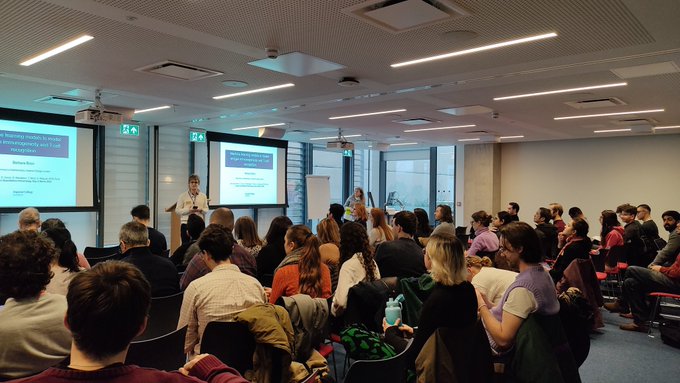
You can find an overview of our research philosophy and research interests here or you can take a look at some of our recent publications. And finally, we have an open door policy for all of our lab meetings, so if you want to get a first-hand impression of what research questions we are currently most excited by come stop by!
Selected News
- May 8th 2026: Come join us for the 4th London Quantitative Immunology Day!
- September 2025: Congratulations to Trupti Gore and James Henderson, who won the Hackathon and poster prize respectively at the Oxford Unravelling T cell recognition conference!
- UCl published a case study Using machine learning to combat rejection in medical transplants on our ongoing collaboration with Alexandra Sharland at University of Sydney.
- July 2025: We organised a UCL New Academics Day to connect new(ish) academics across faculties. Get in touch to join our network.
- June 2025: Andreas has been promoted to Associate Professor from October 1st.
- April 10th 2025: We organised the 3rd London Quantitative Immunology Day.
- October 2024: Congratulations to Dr. Yuta Nagano for his successful PhD defense and for being shortlisted for the IJEP Woolf Prize for best MBPhD thesis at UCL!
- July 2024: Our Wellcome Discovery Team Award was funded enabling us to study the clonal and functional T cell determinants of protection and pathogenesis in tuberculosis for the next eight years.
- March 14th 2024: We organised the 2nd London Quantitative Immunology Day.
- January 2024: The London Quantitative Immunology Network now has a mailing list: Sign up instructions here.
- December 2024: Our Type 1 Diabetes Grand Challenge award was funded enabling us to study mathematically how combination immunotherapies impact different immune cells involved in this autoimmune disease.
- December 2023: Silver and Bronze for the Q-Immuno lab in the IMMREP23 TCR Specificity Prediction Challenge!
- August 6 - 27, 2023: We co-organized a workshop on “Statistical physics and adaptive immunity” at the Aspen Center for Physics.
- March 9th 2023: We organized the 1st London Quantitative Immunology Day.
- July 25 2022: First paper from lab out on bioRxiv! Our first foray into deciphering TCR specificity quantitatively.
- April 2022: The lab opens its doors at UCL!
- Mar 15 2022: Andreas gave an invited talk at the APS march meeting in the Sensing chemical spaces session.
- December 11-13 2019: We organized a conference at PCTS on Sensing chemical spaces. Video recordings of the lectures are available here.
Selected Publications
Y Nagano, A Pyo, M Milighetti, J Henderson, J Shawe-Taylor, B Chain, A Tiffeau-Mayer Contrastive learning of T cell receptor representations, Cell Systems, 2025
A Mayer, C Callan Measures of epitope binding degeneracy from T cell receptor repertoires, PNAS, 2023.
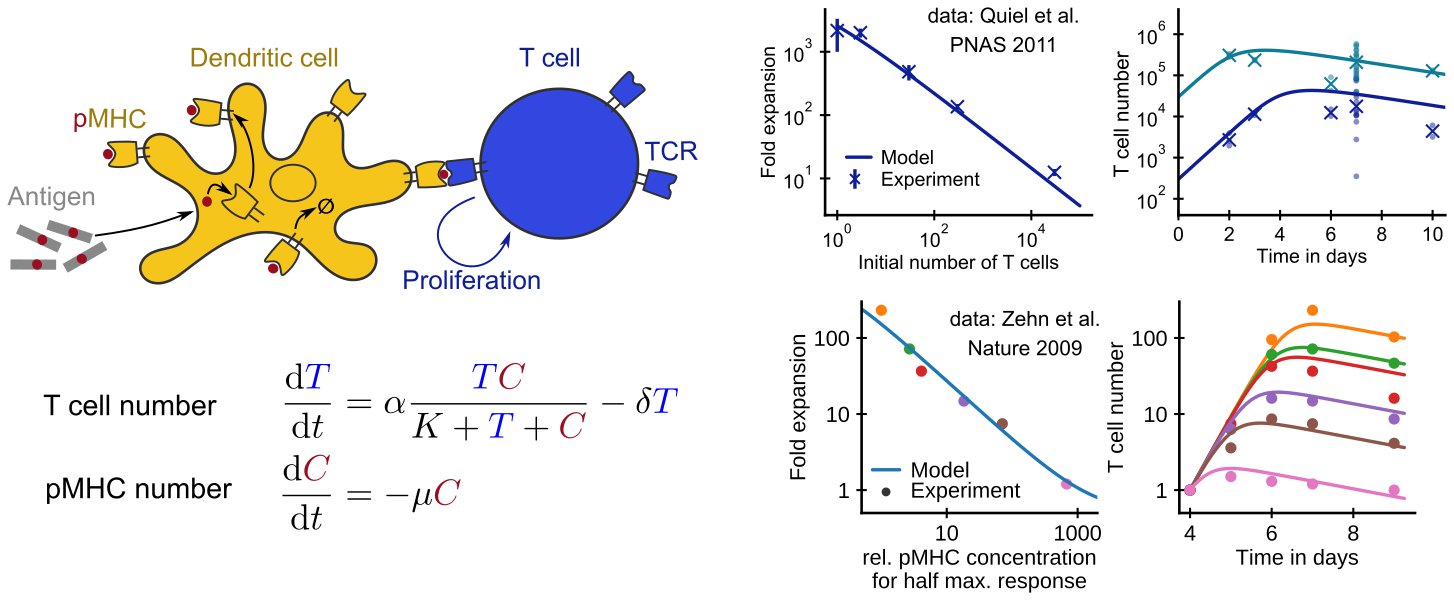
A Mayer, Y Zhang, AS Perelson, NS Wingreen, Regulation of T cell expansion by antigen presentation dynamics, PNAS, 2019.
A Mayer, O Rivoire, T Mora, and AM Walczak, Diversity of immune strategies explained by adaptation to pathogen statistics, PNAS, 2016.
Image Gallery